Food safety
Is it true that nobody ever died from eating moldy bread?
By Fede5 min read
In short
If you ate a bit of moldy bread, you'll most likely be fine: just keep an eye on how you feel that day. But nothing happening today doesn't mean it's harmless. Some molds release toxins you can't feel in the moment, and eaten regularly over years they're linked to a weakened immune system and cancer. Toasting doesn't remove them. That's why moldy bread goes in the trash, whole.
Every time I talk about mold on bread, the same comment shows up: "I've been cutting the moldy part off my whole life and I'm still alive and kicking." And honestly, they have a point.
If you ate a little moldy bread, you'll most likely be fine. The problem is the conclusion we draw from that: nothing happened, so it must be harmless. That's the trap.
What happens if I accidentally ate moldy bread?
Usually, nothing. Lillian Craggs-Dino, a dietitian at Cleveland Clinic, puts it plainly: if you ate something moldy by accident, you'll probably be okay. No need to rush to the ER.
What she does recommend is paying attention for the rest of the day. If you get shortness of breath, nausea, a fever or diarrhea, get medical help right away, because some reactions are immediate and others take a while.
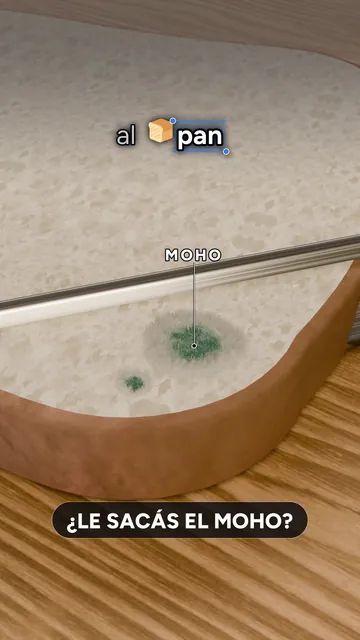
There's one more thing worth keeping in mind: there's no way to tell by sight whether a mold is harmless or dangerous. That green, white or black spot doesn't come with a label. So "this one looks like a mild mold" doesn't mean anything.
Nothing happening today doesn't mean it never will
This is the heart of it. Some molds produce toxic substances called mycotoxins (fungal toxins, since mold is a fungus). And what they do isn't something you feel the next day.
The World Health Organization explains that their effects range from acute poisoning to long-term problems such as a weakened immune system and cancer. Among the most studied are aflatoxins, which the WHO counts among the most poisonous mycotoxins: they can damage DNA, and there's evidence they cause liver cancer in humans.
See the problem? If eating mold regularly for years weakened your immune system or added to your cancer risk, you'd never connect it to that loaf of bread. There's no stomachache to warn you. That's why "I'm still alive and kicking" proves nothing: the possible harm isn't the kind you notice.
I don't want to overstate it, either. What the WHO says applies to mycotoxins in general, not to one particular slice. The point is not to keep adding them up, and the easiest way to avoid that is not to eat food that has mold on it.
So is it true that nobody ever died?
People have died, though not from a slice of bread. In 2004, in Kenya's Eastern and Central provinces, there was an outbreak of aflatoxin poisoning. According to the CDC report, by July 20 of that year there had been 317 cases and 125 deaths: nearly 4 out of every 10 people who got sick.
What had they eaten? Homegrown maize (corn), harvested during the peak of the rainy season and stored damp. People who kept it inside the house instead of in a granary were at higher risk. With all that moisture, the maize filled up with mold.
In more than half of the samples tested, aflatoxin was above the 20 ppb (parts per billion) limit. In some households it reached 8,000 ppb, 400 times the allowed level.
It's an extreme case: it was everyday food, eaten in huge amounts. But it's enough to show that mold toxins aren't an old wives' tale.
What if I toast it or heat it up?
That doesn't help either. The Singapore Food Agency explains that once aflatoxins form, they're chemically stable and hard to eliminate, even at the high temperatures of roasting, baking or frying. The WHO says something similar about most mycotoxins: they survive food processing.
In other words, the toaster may kill the mold, but it doesn't take away what the mold already left behind.
Why isn't cutting off the green part enough?
Because the spot is only what you can see. Mold builds a network of very thin threads, called hyphae, that work like roots and grow into the food. How far they've spread isn't always visible, and the tips of those threads are where some molds release their toxins.
Bread is also soft and full of tiny holes, so the hyphae spread fast and far. Even if you cut away a big piece around the spot, you have no way of knowing how far it got. I explain this in more detail in why cutting the mold off bread isn't enough.
What to do with moldy bread
- Throw out the whole piece, not just the spotted part.
- Check the slices next to it: mold spreads from one to another.
- Keep bread dry and in a container that seals well: moisture is what helps mold the most. That goes for homemade bread too, like my sandwich bread.
- In hot, humid places, the Singapore Food Agency recommends storing food dry, below 80% humidity; cool, under 20 °C (68 °F); and free of insects.
- If you ate some by accident, don't panic: keep an eye on how you feel that day and get help if you have shortness of breath, nausea, a fever or diarrhea.
The idea isn't to panic over one bite, but to stop thinking that "nothing happened to me" means "it does nothing." With bread, the rule is simple: if it has mold, it goes in the trash.
Frequently asked questions
What should I do if I ate moldy bread?
Nothing special: you'll most likely be fine. Keep an eye on how you feel that day and get medical help right away if you have shortness of breath, nausea, a fever or diarrhea.
Does toasting moldy bread destroy the toxins?
No. Aflatoxins are chemically stable and aren't eliminated even at the temperatures used for roasting, baking or frying.
Can bread mold cause cancer?
Some molds produce mycotoxins that, according to the WHO, are linked over the long term to a weakened immune system and cancer; aflatoxins, to liver cancer. One bite is nothing to panic about, but it's best not to keep adding them up.
Can you tell by looking whether a mold is dangerous?
No. There's no way to tell a harmless mold from a toxin-producing one by sight, whatever its color.
Related recipes
Sources
The facts in this post come from these sources (checked when it was written).
- What Happens if You Accidentally Eat Moldy Food? — Cleveland Clinic (Lillian Craggs-Dino) (2021)
- Mycotoxins — Organización Mundial de la Salud (2023)
- Outbreak of Aflatoxin Poisoning — Eastern and Central Provinces, Kenya, January–July 2004 — CDC, MMWR (2004)
- Aflatoxins and Food Safety — Singapore Food Agency (2022)
- Eat well: Is it safe to cut mould off food? — The Conversation (Ailsa Hocking y Tom Ross), republicado por SBS Food (2014)
- Handling Food with Mold — UConn Extension (EXT063) (2024)