Common mistakes
How Much Does a Cup of Sugar Weigh? Granulated vs. Powdered
By Fede4 min read
In short
The same cup filled with granulated sugar weighs 198 g, and filled with powdered sugar, 113 g: almost half. That's why weighing is better. They also do different jobs: granulated sugar crystals beat air into butter, which is why the mixture turns paler. Powdered sugar has no crystals to cut through, so it doesn't work for creaming, but it makes very tender cookies.
Sofi found a recipe that called for a cup of powdered sugar. She didn't have any, so she filled the same cup with regular granulated sugar: sugar is sugar, right? But those two cups don't weigh anywhere near the same. And in the dough, they don't do the same job either.
Same cup, almost twice the sugar
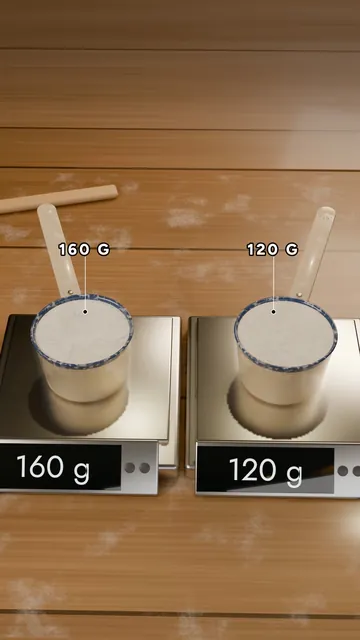
According to King Arthur Baking's ingredient weight chart, a cup of granulated sugar weighs 198 g. A cup of unsifted confectioners' (powdered) sugar weighs 113 g. In other words, the powdered sugar weighs just over half as much.
If the recipe called for a cup of powdered sugar and you used granulated, you added about 85 g of extra sugar. And if it's the other way around, you came up short by almost half.
Powdered sugar isn't a different product: according to King Arthur, it's granulated sugar ground into a fine powder, with a bit of cornstarch added so it doesn't clump. What changes is how much fits in the cup.
Something similar happens with flour: a cup can hold 40 g extra depending on how you fill it. That's why King Arthur recommends weighing your ingredients with a digital scale. In my recipes, I weigh everything.
Why you beat butter with sugar
In lots of cookies and cakes, the first step is beating soft butter with sugar. It isn't just to mix them.
According to King Arthur, as the two are beaten together, the hard sugar crystals create pockets of air in the butter, and those bubbles later make the cake lighter. The Exploratorium, San Francisco's science museum, describes it this way: the jagged edges of the crystals drag air in, and the butter gets lighter in both color and texture.
That's why the mixture turns paler as you beat it: it's the sign that air is getting in. Oil, on the other hand, can't hold that air, which is why it doesn't work in recipes that cream the butter.
Granulated sugar is just the right size for this. King Arthur explains that its crystals are medium-sized and uniform: small enough to dissolve into the batter and large enough to create air pockets when creamed with butter.
Why powdered sugar doesn't work for creaming
Powdered sugar has no crystals to cut through the butter. According to King Arthur, that's why it isn't good for creaming, and their guide says not to use it in place of granulated sugar.
But what it lacks can also be put to use. Since it doesn't add air, it works very well in dense, buttery cookies like shortbread: they turn out very tender and melt in your mouth. If a recipe calls for powdered sugar, there's a reason.
How long to beat it
In my recipes, room-temperature butter is beaten with the sugar until it's creamy:
- In the vanilla cookies, 110 g of butter with 100 g of sugar, and only then the egg.
- In the 3-ingredient cookies, 170 g of butter with 100 g of sugar, well beaten before adding the flour.
- In the oatmeal chocolate chip cookies, the butter goes in with the white and brown sugar until creamy.
I beat it for a few minutes, until it turns paler. If you only mix it for a few seconds, that air doesn't get in. And if your cookies still come out hard, it may be something else: the oven or too much flour.
Frequently asked questions
How much does a cup of sugar weigh?
According to King Arthur Baking's chart, a cup of granulated sugar weighs 198 g. A cup of unsifted powdered sugar weighs 113 g, just over half.
Can I use granulated sugar instead of powdered sugar?
It isn't the same. By the cup, granulated weighs almost twice as much, so you add a lot more sugar. They also work differently: granulated beats air into butter and powdered doesn't. King Arthur advises against swapping one for the other.
Why do you cream butter and sugar?
Because the sugar crystals create pockets of air in the butter. Those bubbles make the cake or cookies lighter. That is why the mixture turns paler as you beat it.
Why doesn't powdered sugar work for creaming?
Because it's a fine powder: it has no crystals to cut through the butter and beat air in. That's why it's used in dense, buttery cookies like shortbread, which come out very tender.
Is it better to weigh or measure with cups?
Weigh. The same cup can hold very different amounts depending on which sugar or flour you use and how you fill it. King Arthur recommends weighing ingredients with a digital scale.
Related recipes
Sources
The facts in this post come from these sources (checked when it was written).
- Ingredient Weight Chart — King Arthur Baking
- A guide to different types of sugars, how to use them, and when to substitute — King Arthur Baking (Rossi Anastopoulo) (2023)
- Science of Cooking: Ask the Inquisitive Cooks — Exploratorium