Common mistakes
Why Are My Cookies Burnt on the Bottom but Pale on Top?
By Fede5 min readUpdated
In short
Cookies burn on the bottom because in most gas ovens the burner sits under the oven floor, and the lower the baking sheet goes, the browner the bottoms get compared with the tops. It's not the oven: it's the rack. Put the sheet on the middle rack and, if they still brown too much, nest a second sheet underneath.
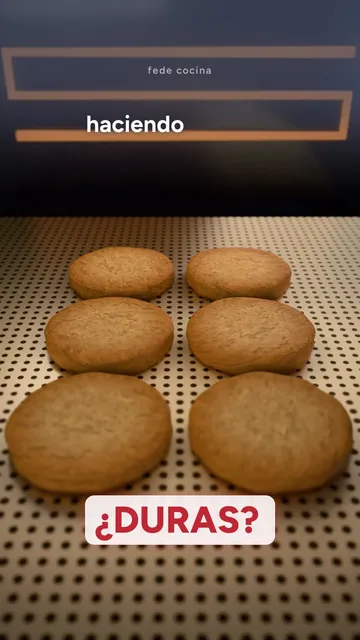
The cookies for alfajores (Argentine sandwich cookies filled with dulce de leche) are supposed to come out pale, with bottoms just barely golden. But you flip one over and the bottom is brown, or flat-out black, while the top is still pale, as if it never went into the oven.
The first thing you think is that your oven bakes badly and needs replacing. It almost never is: the problem is where you put the sheet. And it takes a minute to fix.
Why do they burn on the bottom and not on top?
In most home gas ovens, the burner sits at the bottom, under the oven floor. That's why, on many models, you light it by hand by holding a match to a hole in the floor: that's how the manual for Orbis gas ovens (an Argentine brand) explains it, for example.
That heat rises, and the first thing it hits is the baking sheet. America's Test Kitchen puts it plainly: the closer the sheet is to the bottom, the browner the bottoms of your cookies will be compared with the tops. On the bottom rack, the underside gets far more heat than the rest and burns before the top has a chance to brown.
And it's not only gas ovens. King Arthur Baking warns that an oven can be much hotter toward the bottom than the top even when the heating element is on top, and gives the same rule: if your cookies burn on the bottom, keep the sheets off the bottom rack.
Alfajor cookies show it more than anything, because they're thin and meant to stay pale: any extra heat from below shows up right away.
Two fixes that don't work
Taking them out sooner
It's the first thing people try: if they burn at 12 minutes, I'll pull them at 9. But the gap between bottom and top is decided by the rack, not the timer. Pull them sooner and the bottoms are a little less brown, while the tops stay pale and raw. You trade one problem for another.
A dark nonstick sheet
It seems helpful because nothing sticks, but it does the opposite. America's Test Kitchen tested several, and every dark nonstick cookie sheet consistently overbrowned the bottoms of the cookies.
Their advice is a sturdy, rimmed sheet without a dark coating: heavy-gauge, light-colored metal, lined with parchment paper. Flimsy sheets that warp in the heat also bake more unevenly.
The fix: the middle rack
Move the sheet up. On the middle rack, the heat reaches them more evenly from below and above, and the cookies come out pale on both sides.
If the recipe doesn't say which rack to use, America's Test Kitchen suggests baking a test sheet with just a few cookies on the middle rack first, before gambling with the whole batch. That's what I do with an oven I don't know: three or four cookies, then I flip them and check the bottoms.
Two more tips from the Orbis manual that help: preheat the oven for about 10 minutes before the sheet goes in, and center the sheet, leaving at least 4 cm (about 1.5 in) between pieces.
If they still brown: nest another sheet underneath
Some ovens run so hot at the bottom that even the middle rack isn't enough. For that there's a bakery trick: bake the sheet set inside another identical sheet, one nested in the other.
King Arthur recommends it for exactly this: the doubled sheet keeps bottoms tender, evenly baked, and pale golden instead of overdone. The bottom sheet acts as a shield, so the burner's heat arrives gentler.
More things that help
- Rotate the sheet. America's Test Kitchen recommends turning it 180 degrees halfway through baking, and King Arthur also advises rotating cookies at the halfway point.
- If you bake two sheets at once, besides rotating them, swap the top one with the bottom one.
- An oven thermometer. To check that your oven holds the temperature it says, America's Test Kitchen recommends one: it's cheap and settles the question.
- Parchment underneath. Always, on a light-colored sheet.
Quick summary
| What happens | Why | What to do |
|---|---|---|
| Burnt bottoms, pale tops | The sheet is too close to the burner | Middle rack |
| Bottoms brown even on the middle rack | The oven runs very hot at the bottom | Nest another sheet underneath |
| Dark bottoms with a dark sheet | Dark sheets overbrown | Light, heavy sheet with parchment |
| Some cookies browner than others | The heat isn't even across the oven | Rotate the sheet halfway through |
My alfajor cookies bake at 180 °C (356 °F) for about 12 minutes: the full recipe is in my dulce de leche alfajores. If your cookies have a different problem and come out hard, check when to take them out of the oven. And if your gas oven gives you trouble from the moment you light it, here's why you have to hold the knob down.
It wasn't your oven: it was the rack.
Frequently asked questions
Which oven rack should you bake cookies on?
The middle rack, unless the recipe says otherwise. If you don't know the oven, try a test sheet with just a few cookies first.
Should you use a dark baking sheet for cookies?
No. Dark nonstick sheets overbrown the bottoms. A light, heavy, sturdy sheet lined with parchment works better.
Do you need to rotate the baking sheet halfway through?
Yes: turn it 180 degrees halfway through. If you bake two sheets, also swap the top one with the bottom one.
How long should you preheat a gas oven?
Orbis recommends heating it for about 10 minutes before you start baking.
Can cookies burn on the bottom in an electric oven too?
Yes: an oven can be much hotter at the bottom than the top even when the heating element is on top. The fix is the same: keep the sheet off the bottom rack.
Related recipes
Sources
The facts in this post come from these sources (checked when it was written).
- Improperly Cooked Cookies — America's Test Kitchen
- Troubleshooting Cookies — America's Test Kitchen
- Things bakers know: Bake your sheet pan… on another sheet pan — King Arthur Baking (Anne Wolf) (2025)
- How to identify oven hot spots — King Arthur Baking (PJ Hamel) (2018)
- Hornos a gas: manual de instalación, uso y mantenimiento — Orbis